

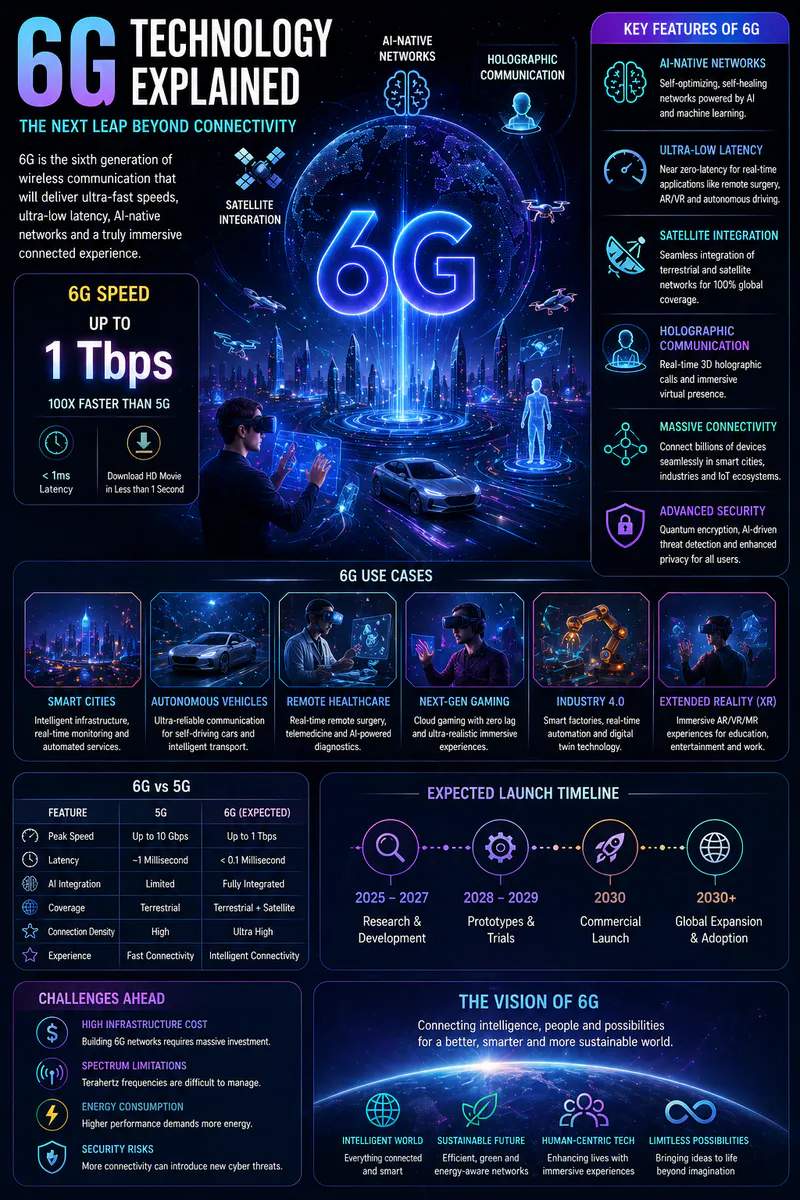
6G Technology Explained – Speed, Features & Launch Timeline
The world is still adapting to 5G, but the tech industry is already preparing for the next revolution—6G technology. Promising ultra-fast speeds, near-zero latency, and intelligent connectivity, 6G is expected to redefine how we interact with digital systems.
From smart cities to holographic communication, 6G will unlock possibilities that currently feel like science fiction.
Let’s break down everything you need to know about 6G in simple terms.
What is 6G Technology?
6G is the sixth generation of wireless communication technology, designed to succeed 5G. It will deliver faster data speeds, improved reliability, and seamless connectivity across devices.
While 5G focuses on speed and IoT, 6G aims to integrate:
- Artificial Intelligence (AI)
- Machine learning
- Advanced sensing technologies
In short, 6G will not just connect devices—it will create a fully intelligent network ecosystem.
6G Speed – How Fast Will It Be?
One of the biggest highlights of 6G is its incredible speed.
Expected 6G Speeds:
- Up to 1 Terabit per second (Tbps)
- 100x faster than 5G
- Ultra-low latency (less than 1 millisecond)
To understand this:
- You could download a full HD movie in less than a second
- Real-time cloud gaming will feel completely lag-free
- 8K/16K streaming will become standard

Key Features of 6G Technology
1. AI-Native Networks
Unlike previous generations, 6G will be AI-driven from the core.
- Self-optimizing networks
- Predictive traffic management
- Intelligent resource allocation
2. Ultra-Low Latency
Latency could drop to nearly zero delay, enabling:
- Real-time remote surgery
- Autonomous vehicles communication
- Instant data processing
3. Integration with Satellites
6G will combine terrestrial networks with satellite systems.
Organizations like NASA and private companies are already exploring space-based internet systems.
This means:
- Global internet coverage (even remote areas)
- No network dead zones
4. Holographic Communication
Imagine attending meetings as a 3D hologram instead of video calls.
6G could enable:
- Real-time holographic video
- Immersive virtual presence
- Advanced AR/VR experiences
5. Smart Cities & IoT Expansion
6G will connect billions of devices seamlessly.
- Smart traffic systems
- Intelligent infrastructure
- Fully automated cities
6. Advanced Security
With AI integration, 6G networks will offer:
- Real-time threat detection
- Quantum encryption
- Enhanced privacy systems
6G vs 5G – Key Differences
| Feature | 5G | 6G (Expected) |
|---|---|---|
| Speed | Up to 10 Gbps | Up to 1 Tbps |
| Latency | ~1 ms | < 0.1 ms |
| AI Integration | Limited | Fully integrated |
| Coverage | الأرض-based | الأرض + satellite |
| Experience | Fast internet | Intelligent network |

Real-World Use Cases of 6G
1. Autonomous Vehicles
Cars will communicate instantly with each other and infrastructure.
2. Remote Healthcare
Doctors can perform surgeries remotely with zero delay.
3. Next-Level Gaming
Cloud gaming will feel like offline gaming.
4. Smart Cities
Cities will become fully automated and efficient.
5. Remote Work Evolution
Holographic meetings could replace video calls.
6G Launch Timeline (Expected)
6G is still under development, but here’s the expected timeline:
- 2025–2027 → Research & testing phase
- 2028–2029 → Early prototypes & trials
- 2030 → Commercial launch (expected globally)
Countries like:
- China
- United States
- South Korea
are leading the 6G race with heavy investments.
Challenges of 6G Technology
Despite its potential, 6G faces several challenges:
High Infrastructure Cost
Building 6G networks will require massive investment.
Spectrum Limitations
6G will use terahertz frequencies, which are difficult to manage.
Energy Consumption
Higher performance means more power usage.
Security Risks
More connectivity can increase cyber threats.
Future of 6G Technology
6G will not just improve internet speed—it will transform how humans interact with technology.
Future Possibilities:
- Brain-computer interfaces
- Fully immersive virtual worlds
- AI-powered digital twins
- Smart environments that respond to humans
It will blur the line between the physical and digital world.
Conclusion
6G technology represents the next leap in wireless communication. With speeds up to 1 Tbps, ultra-low latency, and AI-powered networks, it will unlock innovations that go far beyond faster internet.
Although it may take a few more years to arrive, 6G is already shaping the future of:
- Communication
- Healthcare
- Transportation
- Entertainment
The journey from 5G to 6G is not just an upgrade—it’s a complete transformation of the digital world.